The material includes a series of ten solid wooden cubes with pale pink velatura finishing and protective transparent varnish layer. The size of the cubes go from 1 cm to 10 cm. USE IN COMBINATION WITH OTHER MATERIALS The pink tower is often used in combination with the brown stairs (SE15), because of the correspondence of some dimensions.
PINK TOWER
€141.90
Tax included
The pink tower gives the child visual education of dimensions, sharpening the ability to distinguish different sizes even if they are very small. As with other Montessori materials for very small children, the pink tower help to develop concentration, willpower and intelligence. It shapes the logical-mathematical mind and helps to develop a sharper observation of the environment, progressively enriching the vocabulary of the child.
Description
Product Details
- Weight
- 2,15
MSE-0020
Reviews
No reviews
16 other products in the same category:
Working with this material refines the auditory capacity up to developing the ability to recognise the sound characteristics of objects even without looking at them (you can do this blindfolded). Like other Montessori materials for very small children, this material helps to develop concentration, will, intelligence and sharpens the observation of the...
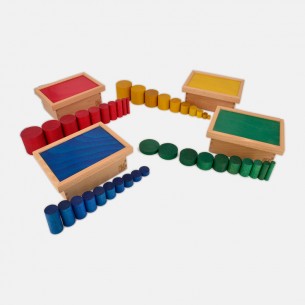
This material can be introduced when the child has become acquainted with the cylinder blocks and colour tablets, starting from the yellow cylinders and proceeding to the red,blue and at last green ones. As other sensorial materials the coloured cylinders sharpen many abilities: gross and fine motoric skills, eye-hand coordination, visual perception...
Placing the tokens in the bowls is a very gratifying activity which educates at recognising and distinguishing the colours and chromatic differences. Like for many other Montessori materials used by very small children it helps to develop concentration, willpower, intelligence and a sharper observation of the surrounding. It also gradually enrichens the...
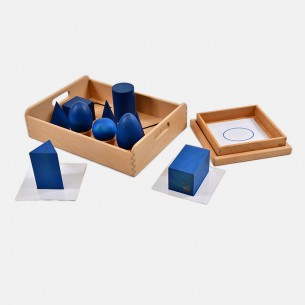
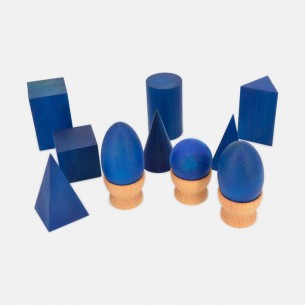
Working with geometric solids, starting at age 4-5, facilitates the development of a child's stereognostic sense and offers one of the first approaches to recognizing geometry in their everyday environment. It facilitates concentration thanks to the ability to manipulate a highly engaging material; it allows for a gradual transition to abstraction,...
This material can be used from three years onward and allows the child to gradually experiment the knowledge of the basic geometric figures through free composition. Further on it is used to discover the geometric relationship between different and similar figures.
This material can be used from 24-30 months onwards. It isolates temperature quality of different surfaces and can be used blindfolded to refine the ability to recognise the temperature of surfaces only by using only the tactile sense, not searching distinctions through sight.
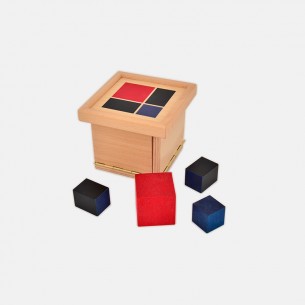
Working with this material refines the child's ability to visually discriminate between color and shape and, like other Montessori materials used by very young children, this work helps develop concentration, willpower, and intelligence. Cubes and parallelepipeds, placed in relation to each other, give a practical representation of the algebraic formula...
This material can be used from three years onwards and develops the sensorial knowledge of plane geometry which will be deepened in the following years. It develops the visual and tactile knowledge of the geometric figures that can be observed consciously in the surrounding area. The sensorial experimentation with straight lines and curves, together with...
This material helps the child to refine its tasting sense. Tasting bottles offer an important key to understanding the environment as well as enriching the child’s vocabulary. Like in other sensorial activities, matching refines the concentration and attention abilities
Working with this material enables the child to recognise tactile characteristics of objects even without seeing them (blindfolded). Developing fine motor skills it is an excellent activity in preparation of writing. Like other Montessori materials for very small children, this material helps to develop concentration, will, intelligence and sharpens the...
These small prisms are used to calculate and compare the volumes of the prisms of the brown stairs.
From the age of 4 years the working with this material the child will learn that all plane geometrical figures can be constructed from triangles. It allows to evaluate the length of the sides and the angles by simply putting more elements one on top of the other. This material is also very useful in primary school, in particular when dyslexic children...
The pink tower gives the child visual education of dimensions, sharpening the ability to distinguish different sizes even if they are very small. As with other Montessori materials for very small children, the pink tower helps to develop concentration, willpower and intelligence. It shapes the logical-mathematical mind and helps to develop a sharper...
As from the age of three, this material introduces the child to studying plane geometry, showing how many plane figures can be made using only identical triangles. This material is also very useful in primary school, in particular when dyslexic children first start to study geometry. The blue triangles can be supported by nomenclatures, drawings or prints.